Agentic systems in financial services are no longer single-model applications. A single customer interaction can trigger multiple model calls, invoke internal systems, touch third-party data sources, and execute downstream actions in seconds. That speed is useful for business operations, but it creates a governance problem: by the time traditional monitoring systems alert, the risky action may already be committed.
This is the compliance timing gap. Most current stacks can observe what happened. Very few can enforce what is allowed before action execution.
XeroML is built to close that gap.
Summary
- Inference-time governance, not post-incident cleanup. XeroML inserts policy enforcement directly in the agent decision path before downstream commit.
- Deterministic controls over stochastic models. Policy logic is versioned and deterministic, even when model outputs vary.
- Audit evidence as a first-class output. Every decision, intervention, and override is captured in an append-only, tamper-evident ledger.
Why Agentic AI Requires a Governance Gateway
Most governance tooling in production today sits in one of three layers:
- Infrastructure observability (uptime, latency, errors)
- Model observability (drift, quality, trace debugging)
- GRC/document management (policies, workflows, attestations)
These layers are necessary, but none is designed to perform preventive compliance controls at the decision boundary. In regulated workflows such as lending, AML, fraud operations, and customer-risk adjudication, delayed detection is not enough. Teams need controls that can block, reroute, or repair actions in real time with full traceability.
That is the role of a governance gateway.
The XeroML Governance Gateway Architecture
XeroML is positioned as governance middleware for agentic finance. The architecture is designed around one principle: evaluate and enforce policy before irreversible outcomes.
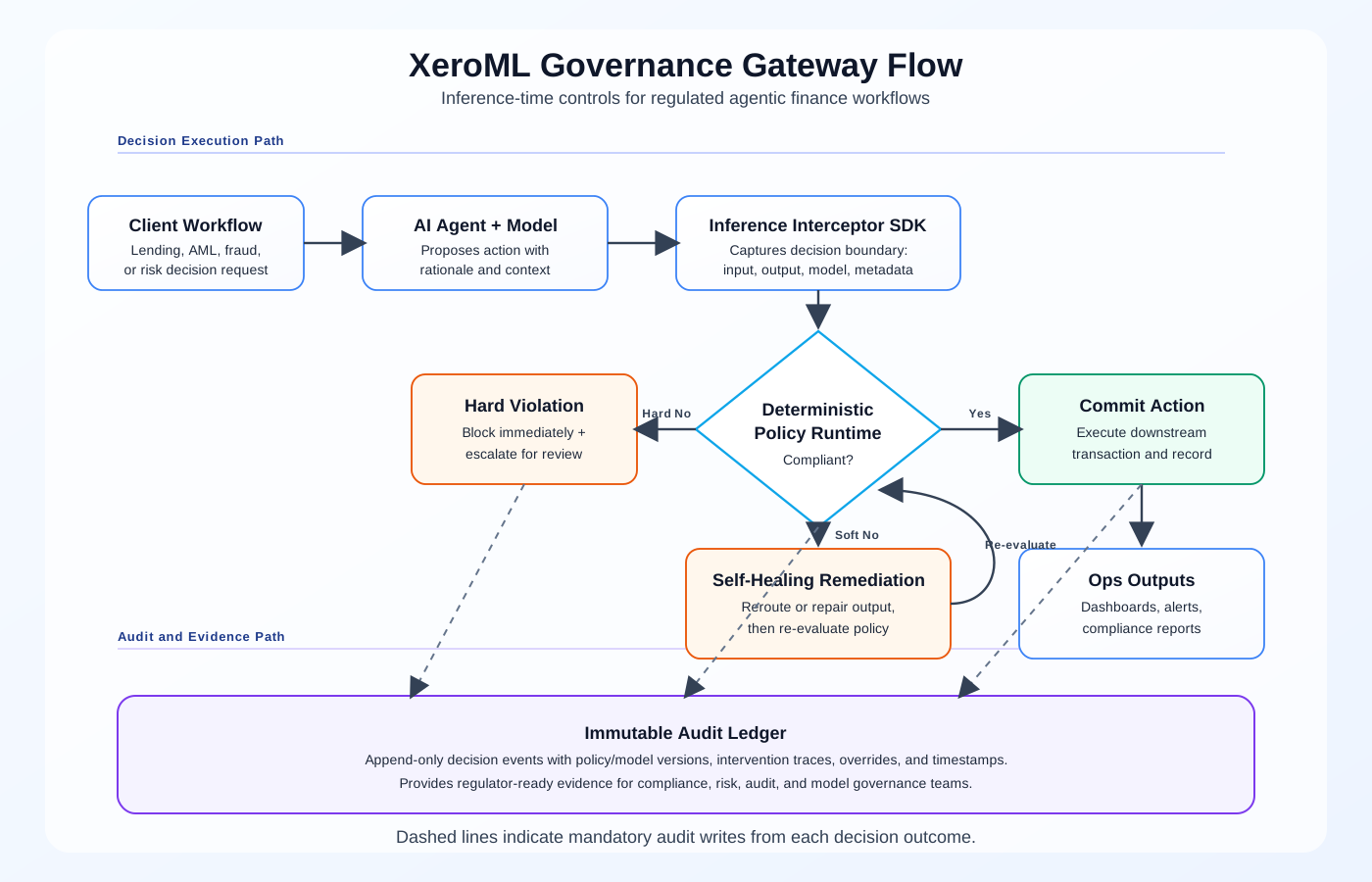
Figure: Decision-path governance flow with deterministic policy checks, remediation loops, and immutable audit logging.
1) Inference Interceptor SDK
The interceptor SDK sits in the model or agent execution path and captures the full decision context: inputs, model identity, prompt/inference metadata, planned action, and execution context. This gives downstream controls a structured decision boundary to evaluate, instead of fragmented logs reconstructed later.
2) Deterministic Policy Runtime
Policy packs are evaluated at commit time by a deterministic runtime. This separates compliance logic from model weights so policy can evolve independently of model deployment cycles. Teams can version, test, and stage policy updates without retraining or replacing underlying models.
3) Pre-Action Blocking and Self-Healing Remediation
When policy violations are detected, XeroML can:
- Block execution for hard violations
- Reroute to an approved path for soft violations
- Repair outputs and re-evaluate before execution
Every branch is logged, including the original attempt, remediation path, and final disposition. This preserves defensibility while reducing operational disruption.
4) Immutable Audit Ledger
All events are written to an append-only, hash-chained ledger with policy and model version references. This produces regulator-ready evidence for model risk, compliance, and audit functions without manual reconstruction during exams.
Fine-Grained Governance at the Decision Boundary
The gateway is intended to enforce governance where it matters most: at the point where an AI output becomes an operational decision.
Key control patterns include:
- Decision-level explainability traces mapped to policy checks
- PII masking controls before downstream writes
- Jurisdiction-aware policy evaluation across regulatory contexts
- Override governance with mandatory rationale and user attribution
- Fail-safe handling with explicit fail-open/fail-closed policy by use case
In other words, XeroML treats compliance as executable runtime behavior, not static documentation.
End-to-End Compliance Observability for Every Team
Agent governance is multi-functional. Different teams require different evidence from the same decision stream.
Compliance and Risk Teams
- Policy pass/fail outcomes by jurisdiction and workflow
- Violation trends with root-cause classes
- Decision-level explainability and adverse-action support data
- Period-ready evidence packs for regulatory review
Engineering Teams
- Full path visibility into intercepted decisions and policy outcomes
- Replay and regression testing against historical traces
- Version impact analysis for policy pack changes
- Faster root-cause analysis of blocked or repaired decisions
Security and Audit Teams
- Identity-linked event trails for every intervention
- Tamper-evident decision records with chain-of-custody
- Consistent evidence exports aligned to internal audit workflows
FinOps and Platform Owners
- Governance overhead visibility by workflow and policy set
- Cost and latency attribution across models, routes, and remediations
- Better operating decisions on when to tighten or relax controls
Built for Regulated Deployment Models
For regulated institutions, architecture is as important as features. XeroML is designed for customer-controlled deployment patterns, including on-prem and VPC-isolated environments, with support for customer-managed key management workflows.
The goal is straightforward:
- Keep governance close to sensitive systems
- Maintain data residency and control boundaries
- Reduce dependence on externalized compliance processing paths
Latency also matters. Governance that is too slow will be bypassed in production. XeroML is engineered for transaction-time operation with low-overhead policy evaluation so teams can keep controls in the critical path, not in a sidecar that gets ignored.
From Monitoring to Inference-Level Compliance
The strategic shift is from retrospective monitoring to preventive runtime control.
Post-inference monitoring answers: “What went wrong?”
Inference-level compliance answers: “Can this action proceed right now under applicable policy?”
For high-consequence workflows, that distinction determines whether governance is merely informative or actually protective.
Implementation Path for Financial Institutions
A practical rollout does not require replatforming everything at once. Most teams can stage adoption:
- Start with one high-regret workflow (for example, underwriting decisions or AML escalation paths).
- Insert the interceptor SDK at the existing decision boundary.
- Deploy baseline policy packs for the target jurisdiction and risk class.
- Enable pre-action controls with explicit escalation and override policies.
- Operationalize audit exports for compliance, internal audit, and model risk functions.
- Expand to adjacent workflows once latency, false positives, and governance quality targets are met.
This phased model helps teams prove value quickly while building confidence in preventive controls.
Closing the Agentic Compliance Gap
Financial institutions do not need fewer dashboards. They need a governance layer that can intervene before risky actions execute, while producing evidence that stands up to scrutiny months later.
That is the purpose of the XeroML Governance Gateway: deterministic enforcement at inference time, integrated remediation, and audit-grade traceability by default.
If you are building regulated AI workflows, you can explore related guidance in our resources on SR 11-7 model validation for AI, ECOA adverse action compliance, and fair lending risk in AI underwriting.